It happened on a rainy Tuesday night in Columbus, Ohio, the kind of night when the wind rattles the windows like a warning you’re too tired to heed. The city felt submerged, the streetlights smearing against the wet asphalt like spilled oil. I was heading home from Riverside General Hospital, my bones aching with a specific kind of exhaustion that only a double shift in the ER can produce.
I was thirty-four years old then, newly divorced, and navigating a life that suddenly felt too large and too empty, like a coat I had shrunk out of. Life, in those days, felt like a long, dimly lit hallway with no doors. I was just walking, placing one foot in front of the other, waiting for a destination that refused to appear.
But destiny doesn’t always knock. Sometimes, it cries.
That sound stopped me dead in my tracks just before I reached my apartment door. It wasn’t the sound of a cat or a mechanical noise. It was the primal, jagged wail of a human life in distress.
There, on the landing, wrapped in a thin, cheap blue blanket that was already damp from the humidity of the hallway, was a baby. He was left like a forgotten package, a piece of unwanted mail. I dropped my keys, the metal clattering loudly on the floor, and fell to my knees. My nurse’s training kicked in before my brain could process the absurdity of the moment.
I pulled back the fold of the blanket. His face was contorted, cheeks flushed a violent red from the exertion of screaming. His breaths were sharp, frightened gasps. I touched his cheek with the back of my hand. Warm. Feverishly warm. Real. Terribly, terrifyingly real.
“Hey there,” I whispered, my voice cracking. “I’ve got you.”
I scooped him up, holding him close to my chest to share my body heat. I knocked on doors—apartment 4B, 4C. I pounded until my knuckles were sore. No answers. No shuffling feet. No guilt-ridden mother peering through a peephole. There was no diaper bag, no bottle, no note. Nothing except a newborn, an umbilical cord that looked amateurishly cut, and the storm raging outside.
I brought him into my apartment, the silence of my living room suddenly shattered by his cries. I dialed 911 with shaking hands.
The police came. They were polite, professional, and detached. They took statements in their notebooks, their radios crackling with the chaos of the city. They shrugged in ways they probably didn’t mean to—a gesture of ‘this happens more than you think’—and then they left. Child Services followed an hour later. More questions. More forms. The baby was taken from my arms and placed into a carrier, labeled in their system as Infant Doe, a cold placeholder for a life that was just beginning.
When the caseworker walked out that door, the silence rushed back into my apartment, heavier than before. But now, the silence was haunted.
Days bled into weeks. The rain stopped, but the fog in my head didn’t. I went back to work. I scrubbed my hands raw before every surgery, trying to wash away the phantom sensation of that warm, tiny weight in my arms. I stayed late to help new parents in the maternity ward learn how to hold their newborns, correcting their grip, soothing their anxieties, all while my own heart felt like it was beating outside my chest.
Each morning on my way home, I paused at that spot in the hallway. I found myself looking for the blue blanket, even though I knew it was gone into an evidence locker somewhere.
Then, one gray Tuesday afternoon, the phone rang.
“Ms. Renee Whitman?” The voice was clipped, bureaucratic. “This is Janet Lewis from Child Services. Due to a severe overflow in placements and your background as a registered nurse, we were wondering… would you consider temporary foster care for the infant found at your residence?”
My heart answered before my brain could calculate the logistics or the bank balance.
“Yes,” I said, gripping the receiver. “Of course. Yes.”
He came back to me two days later with a tiny onesie that read ‘Mommy’s Little Hero’ and a thick manila folder full of medical records. Temporary became routine. Routine, insidious and beautiful, became love.
I named him Grayson.
Life stretched and reformed around him. I moved from night shifts to days, a decision that cost me the promotion to Head Nurse I had been fighting toward for five years. My bank account shrank as formula and diapers replaced takeout and savings. My patience, however, expanded into a universe.
Friends drifted away, their invitations to happy hours replaced by polite excuses. My parents shook their heads, warning me about “getting too attached” to a ward of the state, but they still showed up every Christmas with trucks and blocks.
Grayson learned to crawl across the living room carpet, catching sunlight in his hair like a halo. He learned to read with his head resting heavy on my lap, his finger tracing the words. He learned that mistakes—spilled milk, broken vases—were not sins, but stepping stones. He learned that he was wanted.
He called me “Mom” before he knew the definition of the word. By the time he was old enough to understand biology, he never used anything else. I told him the truth, gently, piece by piece, as he grew. I told him that someone else had given him life, but I was the one who was keeping it safe. I told him that being chosen can happen more than once in a lifetime.
He accepted it with the quiet confidence of a boy who has never had to question his place at the dinner table.
Seventeen years passed in a blink of scraped knees, science fairs, and late-night fevers.
Then came the second knock.
It wasn’t a baby at the door this time. It was a man in a dark, bespoke suit. He wore polished oxfords that cost more than my car and a raincoat that suggested he had never had to run for a bus in his life. He verified my identity and handed me a thick envelope of legal documents.
I opened them at the kitchen table, my hands trembling. A name I did not recognize stared up at me, bold and black against the white paper.
Valerie Sutton.
His biological mother.
I spent the next forty-eight hours on the internet, fueled by panic and caffeine. Valerie Sutton wasn’t just a name; she was a brand. She was a woman who had built a tech empire in Seattle. She was the founder of a startup sold for hundreds of millions. She was recently widowed, childless in the eyes of the public, and wielding a checkbook that could buy half of Columbus.
She wanted to reclaim the child she had left in a hallway nearly two decades ago.
The petition claimed she had been suffering from postpartum psychosis at the time, that she had been young, scared, and without resources. Now, with a team of lawyers and a clean bill of mental health, she wanted to nullify the adoption on a technicality regarding the “abandonment” timeline.
I looked at Grayson, who was sitting on the couch playing a video game, oblivious to the fact that the ground beneath us was dissolving.
“Mom?” he asked, not looking up. “You okay? You’ve been staring at that wall for twenty minutes.”
“I’m fine,” I lied. “Just thinking.”
But I wasn’t thinking. I was drowning.
I sat in a courtroom three weeks later. The room smelled of old wood and lemon polish. The flags loomed behind the judge like stern sentinels guarding a gate I wasn’t allowed to pass. My hands shook so badly I had to clasp them together in my lap until the knuckles turned white.
Grayson sat beside me. He was wearing his only suit, the one we bought for homecoming. His jaw was clenched so tight a muscle feathered in his cheek.
The doors opened, and Valerie Sutton entered. She moved like someone used to bright lights and deference. She had perfect posture, diamond earrings that caught the harsh fluorescent light, and a team of lawyers flanking her like a fortress. She looked at me, then at Grayson. Her expression was unreadable—a mix of hunger and sorrow.
The proceedings were a blur of legalese. Her lawyers painted a picture of a tragic, confused young woman who had made a terrible mistake and spent eighteen years building a life worthy of her son. She testified with tears that seemed genuine.
She said she never meant to abandon him permanently. She said her new stability made room for him now. She talked of Ivy League colleges, international travel, influence, and legacy. She spoke of giving him the world.
I sat there in my department store blouse, thinking about the shift I had to work the next day, the Honda that needed a new transmission, and the college fund that was barely enough for a state school. I felt small. I felt like a placeholder again.
The judge, the Honorable Marcus Callahan, listened intently. He took notes. He frowned. Then, he turned his gaze to the boy sitting next to me.
“Son,” Judge Callahan said, his voice rumbling through the room. “At seventeen years old, your voice carries significant legal weight in this state. Is there anything you would like to say before I make a decision regarding custody and visitation?”
The courtroom hushed. The silence was thick, pressing against my eardrums.
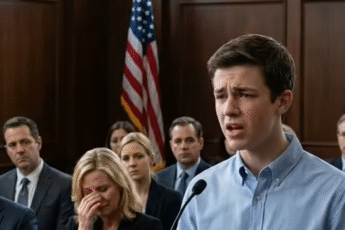
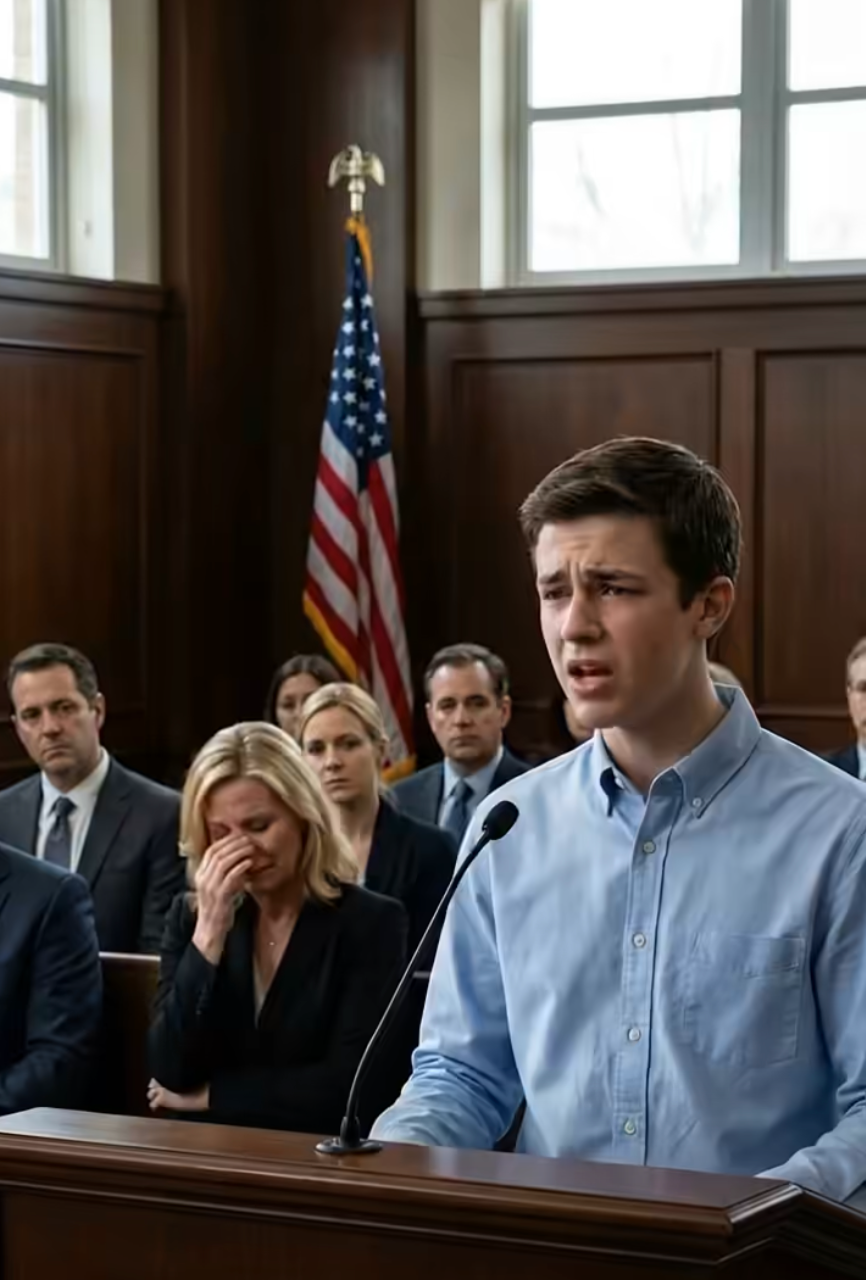
Grayson rose slowly. He didn’t smooth his tie. He didn’t look at the lawyers. He didn’t look at Valerie at first. He looked straight at the judge.
“I know she is my mother biologically,” Grayson started, his voice cracking slightly before finding its rhythm. “I have known that my whole life. My mom—” he gestured to me, “—never hid that from me.”
Valerie’s eyes glimmered with hope. She leaned forward slightly.
“But your Honor,” Grayson continued, turning to look at Valerie for the first time. “Blood is not the thing that sat with me for three nights straight when I had pneumonia and my fever hit 104. Blood is not what learned to braid my hair for picture day because Mom was crying in the bathroom after her divorce but wanted me to look good. Blood is not what helped me fill out college applications at two in the morning with cold pizza and pep talks when I wanted to quit.”
He took a breath. “Blood did not stay.”
His voice wavered, but his spine did not. He looked like a man.
He looked directly into Valerie’s eyes. “I do not hate you. I am thankful for my life. But I do not want to be claimed like property because I suddenly matter to your legacy. I do not want to trade the woman who raised me for a stranger with resources.”
Gasps fluttered through the crowd. Valerie reached a hand forward, as if to touch him across the aisle. The judge raised a hand. Silence slammed back into the room.
Grayson wasn’t finished. “I want to meet her,” he said, nodding at Valerie. “I’m curious. But I just do not want to lose the woman who already feels like home.”
He sat down. I reached out and took his hand. His palm was sweating.
Judge Callahan nodded slowly, looking over his spectacles. “The ruling will not come today,” he announced. “Court is adjourned.”
The ruling didn’t come that day because courtrooms are slow, grinding machines. Instead, the judge ordered mediation. Counseling. Negotiated visiting schedules. The court recognized Valerie’s parental rights, but they explicitly stated they did not override mine. Custody remained where it had been for seventeen years: with me.
But the door had been cracked open.
The press swarmed outside the courthouse. Flashbulbs burst around us like tiny explosions. A reporter shoved a microphone in Valerie’s face.
“How do you feel, Ms. Sutton?”
She wiped a stray tear, composed herself, and said, “Hopeful.”
Someone asked Grayson the same question. He looked at the camera, looked at me, and said nothing. He just got into our dented Honda and turned up the radio.
At home that night, the house felt too quiet. The rain pattered outside again, like a loop closing, bringing us back to that first night. Grayson sat on the couch, elbows on his knees, staring at the blank television screen.
“Mom,” he asked without looking up.
“Yeah, Gray?”
“Would you hate me if I tried to get to know her?”
My throat tightened. It felt like swallowing glass. I thought of the hallway. The blue blanket. The years I held him through fear and fevers and heartbreak. I thought of the fear of losing him, which was sharper than any physical pain I had ever known.
I walked over and sat beside him. “No,” I said, forcing my voice to be steady. “I could never hate you. I just want you to stay rooted in what is real. Don’t let the glitter blind you.”
He nodded. “I know.”
The next six months were a strange, agonizing balancing act.
Valerie invited him to brunches at expensive restaurants in Seattle. He declined the private flights she offered, choosing economy seats on commercial airlines instead. “I’m not a package,” he told her.
He sat across from her in glass-walled offices overlooking the Puget Sound while she spoke about opportunities, internships at her company, and connections I could never dream of providing.
He came home from these trips exhausted, not physically, but emotionally. He would dump his bag in the hall and find me in the kitchen.
“She asks a lot of questions,” he said one night, eating cereal at the counter.
“Like what?”
“Like… what I want to be. Who I want to be.”
“And what do you say?”
“I ask her questions back,” he said. “Questions she doesn’t expect.”
He told me about their conversations.
“Why did you wait this long?” he had asked her over a plate of $40 truffle pasta.
“Why now?”
“Do you want me, or do you want the idea of having a son?”
Sometimes she answered with tears. Sometimes with silence. He told me that after the first meeting, he had just stared at her.
“She is trying, Mom,” he said, curling up on the couch beside me, staring at the ceiling. “It just feels like she is trying for a version of me that exists only in her imagination. She wants a CEO in training. She got… me.”
“You’re pretty great,” I said, stroking his hair.
“Relationships rarely move in a straight line,” he murmured, quoting something I used to tell him about girls. “They zigzag. They collide. They retreat.”
Three months later, the court finalized the arrangement. Valerie’s rights were acknowledged. Custody was unchanged. Grayson was allowed full autonomy. The judge recommended a relationship, not a replacement.
It felt fair in theory. In practice, it hurt like hell.
Valerie cried in the courtroom when the final gavel fell. Not performatively. Not for the cameras. Quietly. She looked smaller than she had the first day. Like someone mourning a door she realized she could never fully reopen, only peek through.
Grayson hugged her before we left. My breath caught at the sight—his height matching hers, the similar set of their shoulders. But then he pulled back, turned, and walked to me.
Life didn’t become perfect after that. Therapy sessions became a monthly bill. Holidays became high-stakes negotiations. Thanksgiving with Renee, Christmas Eve with Valerie. Valerie sent lavish birthday checks. Grayson sent polite thank-you cards instead of the immediate acceptance she probably craved.
He chose boundaries. He chose balance. He chose me, too. Not exclusively, because that wasn’t the choice anymore. But not defensively either. He chose me simply because love, once earned, leaves fingerprints that never fade.
Years from that first knock on my apartment door, I stood in the hallway again. But this time, I wasn’t finding a baby. I was watching a man leave.
Grayson stood in the kitchen, taller than the doorframe, shoulders steadier than mine had ever been at his age. He was packing for college—a state university two hours away, not the Ivy League school Valerie had pushed for.
“Mom,” he said, stuffing clothes into a duffel bag with the chaotic energy of an eighteen-year-old. He paused, holding a stack of t-shirts. “I wanted to tell you something.”
“What is it?”
“I am not choosing between you and her anymore,” he said. “I am choosing myself. I’m taking the relationship with her at my own speed. But I need you to know… I’m not trading up.”
I stepped forward and straightened his collar, fighting back the tears that had been threatening to spill for eighteen years. “I know.”
“I just hope that is enough for both of you,” he said softly.
“It always was,” I whispered. “You were always enough.”
He is eighteen now. He visits Valerie sometimes. Sometimes they argue about politics or his career path. Sometimes they sit in silence and let the years between them speak. He sends her photos of sunsets from campus, polite and distant.
But he sends me videos of squirrels stealing snacks outside his dorm at 2 AM. He calls me when he has a fever. He calls me when his heart breaks.
He belongs to the world in ways I never saw coming. He belongs to himself. And I am learning to let that be enough.
People ask if I was afraid of losing him during the trial. I was. I was terrified. It felt like my heart was walking around outside my body, unprotected. But motherhood is not measured by possession. It is not about whose DNA built the bones. It is measured by presence.
It is measured by the nights you stay, even when you are scared. By the mornings you greet with empty hands and still offer love. By the willingness to be the safety net, even when you are fraying.
If you stood where I stood, looking at that bundle in the rain, would you fight harder? Would you let go sooner? Would you trust a bond built through seventeen years of scraped knees, burnt toast, and late-night fevers over the pull of blood and billions?
If you were Grayson, would you walk toward the mother who returned with the world in her hands, or cling to the mother who stayed when she had nothing but a blue blanket?
There is no simple answer. Family is not always who starts the journey with you. Sometimes it is who waits on the path. Who holds a light when the way back seems impossible. Who stays.
If you want more stories like this, or if you’d like to share your thoughts about what you would have done in my situation, I’d love to hear from you. Your perspective helps these stories reach more people, so don’t be shy about commenting or sharing.